The International Food Policy Research Institute (Ifpri) says reducing the spread between the official and parallel market rates cannot be as inflationary as widely feared as imports are already priced at informal exchange rates.
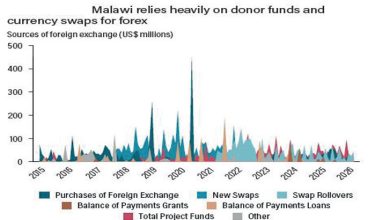
In its study titled ‘Does Malawi exchange rate regime keep prices low? Evidence and policy implications’, the think-tank said foreign exchange scarcity means that most goods are already priced at parallel market rates.

The study noted that reducing the spread could lead to price increases of between six and 23 percent, which can be managed with reforms to stabilise the economy.
Reads the study in part: “While an official devaluation would, in principle, raise the domestic price of imports by around 151 percent, the severe rationing of foreign exchange in Malawi has meant that most food and manufactured imports are already priced at the informal rate.
“Currency unification would, therefore, have a more limited direct effect on food prices and, thus, food consumption than what is commonly assumed.”
Ifpri pointed to fuel hikes in October 2025, January an April this year, which pushed up fuel prices, saying a formal devaluation could add only 7.2 percentage points to the increases.
Fertiliser, chemicals and machinery would rise by between six and 23 percent as many are already imported at parallel rates.
The findings of the study have drawn mixed reactions with University of Malawi economics lecturer Edward Leman warning in an interview on Sunday that past attempts to align official and parallel exchange rates often led to new premiums rather than convergence.
He said: “While exchange rate unification may have broader economic benefits, caution is warranted regarding expectations of limited price increases.
“Empirical evidence also points to a strong exchange rate pass-through to inflation in Malawi.”
Leman said given the country’s persistent foreign exchange shortages and limited reserves, it is reasonable to expect the parallel market to continue trading above the official rate even after devaluation.
“Studies indicate that exchange rate movements are a significant driver of domestic prices,” he said.
In its recent policy brief, National Planning Commission urged a transparent shift to a flexible regime, stressing that unification should be part of wider reforms, including sound fiscal and monetary policies.
Reads the policy brief in part: “The priority now is to complete exchange rate unification so that Malawi can put an end to opaque and uncertain access to foreign currency, allowing importers to source essential inputs, formal exporters to be rewarded at the true value of their outputs and investors to plan and repatriate profits with confidence.”
Meanwhile, Ministry of Finance, Economic Planning and Decentralisation has outlined measures under the five-year National Economic Recovery Plan (Nerp), including tighter regulation of foreign exchange markets, annual licence reviews and scaling up gold purchases to build reserves.
Reads the Nerp in part: “The outlined measures will assist in improving supply of foreign exchange on the market. Further interventions in the fiscal sector will curtail liquidity injections and reduce demand for foreign exchange.
The International Monetary Fund has also flagged misalignment as a source of distortion in the currency foreign exchange market.